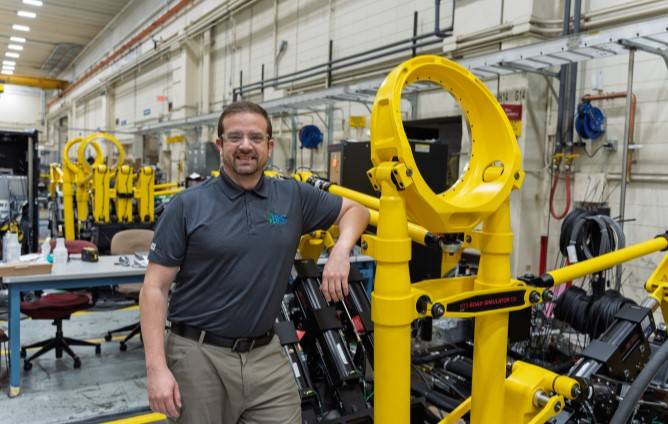
Damper Set-up, Tuning & Evaluation
Perform damper system set-up, tuning, and vehicle-level evaluation with only a subsystem of parts in a laboratory environment.
Laboratory-based damper system set-up and tuning allows engineers to optimize damping characteristics and vehicle dynamics using only the subsystem of parts, without the need for a complete vehicle. OEMs, tier-one suppliers, and motorsports teams conduct these tests to evaluate damping response, fine-tune valve settings, and assess performance under simulated vehicle conditions. Hybrid simulation enables real-time interaction between the damper and a virtual vehicle model, providing accurate correlation to vehicle behavior while reducing testing time and prototype costs.
Test Methods
Damper set-up, tuning, and evaluation use controlled displacement, velocity, and force inputs to replicate realistic vehicle operating conditions in the laboratory. Standardized procedures include sinusoidal sweeps, multi-speed ramps, and road-load simulations to evaluate damping response across the full stroke range. Tests may apply velocity- and force-controlled cycles to assess friction, hysteresis, and dynamic stiffness under varying environmental conditions. Subsystem evaluation often involves real-time interaction with a virtual vehicle model to simulate road inputs and suspension dynamics, ensuring accurate correlation to vehicle-level behavior. Data acquisition captures force, velocity, and displacement at high fidelity, while repeatable test sequences verify damping characteristics, valve settings, and friction behavior. These methods enable engineers to optimize damper performance, validate subsystem behavior, and reduce costly on-road testing while adhering to SAE, ISO, and OEM-specific tuning standards.
Test Results
Data from damper set-up and tuning allows engineers to optimize damping rates, verify subsystem behavior, and correlate results with full-vehicle performance. R&D labs, OEMs, and suppliers use this information to ensure consistent ride and handling, validate virtual vehicle models, and reduce track testing, supporting faster, more accurate development cycles.
MTS Product Solutions
MTS offers an integrated portfolio for damper tuning and evaluation. FlexTest® Controllers provide precise multi-channel actuation and control. The mHIL Damper system enables hybrid simulation with virtual vehicle interaction for vehicle-level correlation. Damper Performance & Quality Test Systems, with servo-hydraulic Model 849 or electric EMA actuators, replicate real-world conditions. MTS Damper Software automates testing, acquisition, and analysis, delivering repeatable, high-fidelity results that accelerate development, optimize damping, and ensure reliable vehicle performance.
Test Methods
Damper set-up, tuning, and evaluation use controlled displacement, velocity, and force inputs to replicate realistic vehicle operating conditions in the laboratory. Standardized procedures include sinusoidal sweeps, multi-speed ramps, and road-load simulations to evaluate damping response across the full stroke range. Tests may apply velocity- and force-controlled cycles to assess friction, hysteresis, and dynamic stiffness under varying environmental conditions. Subsystem evaluation often involves real-time interaction with a virtual vehicle model to simulate road inputs and suspension dynamics, ensuring accurate correlation to vehicle-level behavior. Data acquisition captures force, velocity, and displacement at high fidelity, while repeatable test sequences verify damping characteristics, valve settings, and friction behavior. These methods enable engineers to optimize damper performance, validate subsystem behavior, and reduce costly on-road testing while adhering to SAE, ISO, and OEM-specific tuning standards.
Test Results
Data from damper set-up and tuning allows engineers to optimize damping rates, verify subsystem behavior, and correlate results with full-vehicle performance. R&D labs, OEMs, and suppliers use this information to ensure consistent ride and handling, validate virtual vehicle models, and reduce track testing, supporting faster, more accurate development cycles.
MTS Product Solutions
MTS offers an integrated portfolio for damper tuning and evaluation. FlexTest® Controllers provide precise multi-channel actuation and control. The mHIL Damper system enables hybrid simulation with virtual vehicle interaction for vehicle-level correlation. Damper Performance & Quality Test Systems, with servo-hydraulic Model 849 or electric EMA actuators, replicate real-world conditions. MTS Damper Software automates testing, acquisition, and analysis, delivering repeatable, high-fidelity results that accelerate development, optimize damping, and ensure reliable vehicle performance.
- FlexTest Controllers provide high-precision, multi-channel control of damper actuators, enabling repeatable motion and force profiles for accurate subsystem evaluation and tuning, ensuring reliable correlation to vehicle-level performance.
- Hybrid Simulation: mHIL Damper integrates dampers with a real-time virtual vehicle model, simulating road inputs and suspension dynamics in real time. Engineers can tune dampers and assess subsystem behavior in the context of the full vehicle without physical prototypes.
- Damper Performance & Quality Test Systems employ servo-hydraulic Model 849 or electric EMA actuators to replicate full-range damper motion. Engineers measure force, velocity, and friction while tuning damping characteristics and validating subsystem performance under controlled, repeatable laboratory conditions.
- MTS Damper Software automates test execution, data acquisition, and analysis for damper set-up and tuning. It provides real-time feedback, ensures repeatable measurements, and enables engineers to optimize damping characteristics efficiently while correlating results to vehicle-level behavior.