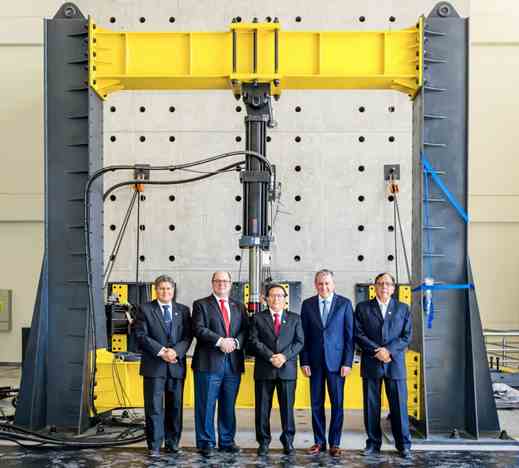
University of Minnesota researchers publish insights and learnings from recent upgrades to the hybrid simulation capabilities of their world-renowned Multi-Axial Subassemblage Testing (MAST) facility.
Dr. Shawn You, MTS Senior Staff Engineer provides an introduction to recent upgrades of the University of Minnesota MAST system's pseudo-dynamic hybrid simulation capabilities, underscoring the critical importance of understanding and managing friction in large 6DOF multi-axial setups. The facility's newly upgraded hybrid simulation capabilities, the methods developed to characterize system friction, and the suite of validation hybrid simulations performed are documented in Earthquake Engineering & Structural Dynamics: Volume 54, Issue 9 (link below).

Friction Characterization and Mitigation in Large-Scale 6DOF Multi-Axial Hybrid Simulation
Access the Published Research
MAST Hybrid Simulation Testing Upgrade:
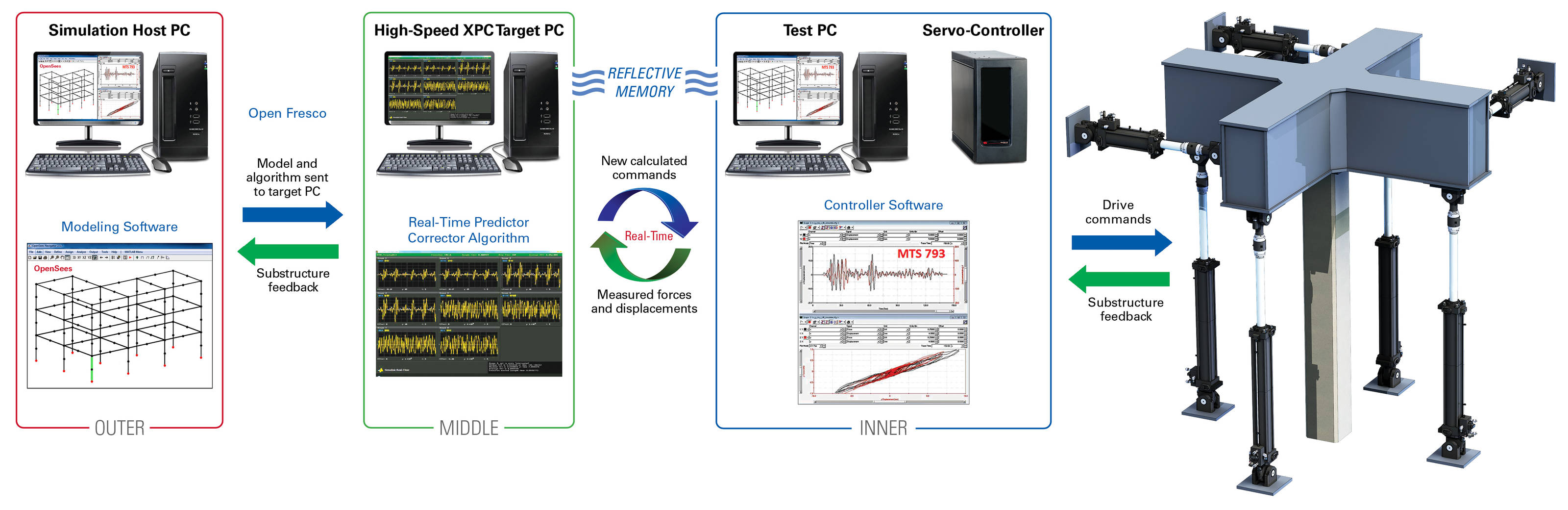
A schematic of the new hybrid simulation control loop linking the 6DOF MAST system with OpenSees and Ansys models through an OpenFresco middleware framework: The system controller transforms actuator feedback into global coordinates and exchanges targets via high-speed reflective memory (SCRAMNet®), while a predictor–corrector algorithm synchronizes numerical integration and actuator motion, enabling stable, multi-axial hybrid simulation performance.
A schematic of the new hybrid simulation control loop linking the 6DOF MAST system with OpenSees and Ansys models through an OpenFresco middleware framework: The system controller transforms actuator feedback into global coordinates and exchanges targets via high-speed reflective memory (SCRAMNet®), while a predictor–corrector algorithm synchronizes numerical integration and actuator motion, enabling stable, multi-axial hybrid simulation performance.
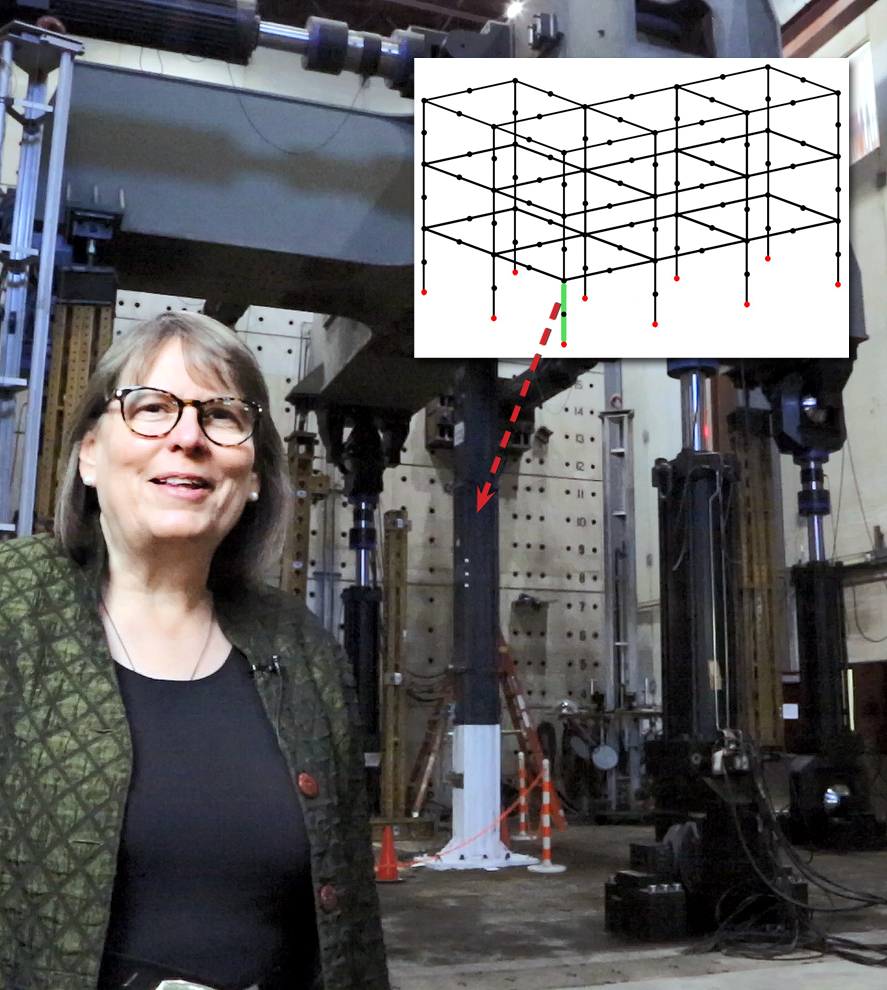
MAST Hybrid Simulation Verification: A series of 5DOF and 6DOF pseudo-dynamic hybrid simulations were performed using the MAST to determine whether system friction levels were low enough for meaningful hybrid simulation, or whether compensation techniques were required. The simulations subjected a numerical three-story multi-bay frame structure and a physical corner column to 1994 Northridge Earthquake inputs.

Hydrostatic Bearing Validation: The verification hybrid simulations revealed that MAST system friction did not exceed 0.23% of the loading capacity of the system, confirming the effectiveness of state-of-the-art MTS hydrostatic bearings in the Z actuator swivels for reducing friction to a negligible amount, eliminating the need to employ complex and potentially time-consuming friction mitigation algorithms and strategies.