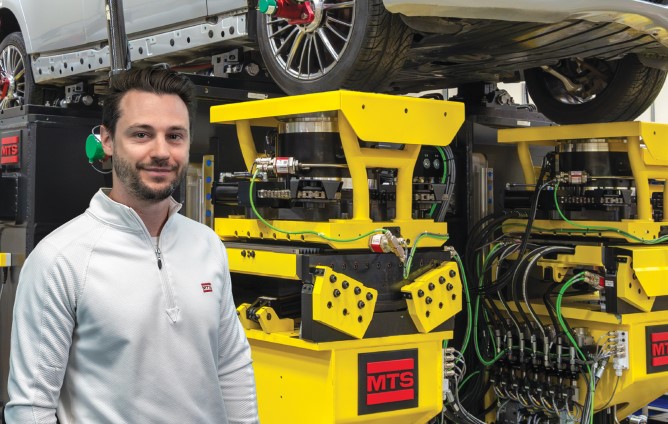
Axle / Suspension Component Characterization
Precisely measure relevant parameters, replicate service conditions, correlate data and ensure performance targets are met.
Characterizing axle and suspension components is essential to ensure parts meet performance and durability targets under real-world conditions. OEMs, tier-one suppliers, and research labs conduct these evaluations to quantify damping, stiffness, compliance, and NVH characteristics. Laboratory testing enables engineers to replicate service conditions, correlate measured data with CAE models, and optimize component designs. These efforts ensure each suspension element contributes as intended to overall vehicle ride, handling, and durability while reducing warranty and development risks.
Test Methods
Axle and suspension component characterization adheres to global standards for measuring stiffness, compliance, damping, and dynamic response. Testing includes static, quasi-static, and dynamic protocols on dampers, bushings, springs, and steering assemblies to replicate real-world loads. Multi-axis actuators apply precise displacement, force, and torque profiles while configurable fixtures maintain realistic boundary conditions. Kinematic & Compliance (K&C) and Dynamic K&C systems capture deflection, stiffness, and modal response across relevant frequencies. Component-specific rigs for dampers, elastomers, and steering elements allow measurement of force-velocity behavior, damping characteristics, and vibration response. Data acquisition collects high-fidelity measurements for correlation with CAE models and design targets. These laboratory methods provide repeatable, accurate results that inform material selection, quality verification, and subsystem integration while ensuring alignment with overall vehicle ride, handling, and NVH performance.
Test Results
Characterization data allows engineers to verify damping, stiffness, and compliance against specifications. Automotive manufacturers and test labs use this information to validate CAE models, optimize component performance, assess quality, and ensure each part contributes to ride, handling, and NVH targets while reducing prototype testing iterations and warranty exposure.
MTS Product Solutions
MTS provides a comprehensive portfolio for axle and suspension component characterization, offering precise actuation, measurement, and multi-axis control. FlexTest® controllers, K&C and Dynamic K&C systems, and dedicated damper, elastomer, and steering test rigs enable accurate replication of real-world service conditions. These solutions deliver repeatable, high-fidelity data for stiffness, compliance, and damping, supporting correlation with digital models, component optimization, and verification of performance and quality targets in a laboratory environment.
Test Methods
Axle and suspension component characterization adheres to global standards for measuring stiffness, compliance, damping, and dynamic response. Testing includes static, quasi-static, and dynamic protocols on dampers, bushings, springs, and steering assemblies to replicate real-world loads. Multi-axis actuators apply precise displacement, force, and torque profiles while configurable fixtures maintain realistic boundary conditions. Kinematic & Compliance (K&C) and Dynamic K&C systems capture deflection, stiffness, and modal response across relevant frequencies. Component-specific rigs for dampers, elastomers, and steering elements allow measurement of force-velocity behavior, damping characteristics, and vibration response. Data acquisition collects high-fidelity measurements for correlation with CAE models and design targets. These laboratory methods provide repeatable, accurate results that inform material selection, quality verification, and subsystem integration while ensuring alignment with overall vehicle ride, handling, and NVH performance.
Test Results
Characterization data allows engineers to verify damping, stiffness, and compliance against specifications. Automotive manufacturers and test labs use this information to validate CAE models, optimize component performance, assess quality, and ensure each part contributes to ride, handling, and NVH targets while reducing prototype testing iterations and warranty exposure.
MTS Product Solutions
MTS provides a comprehensive portfolio for axle and suspension component characterization, offering precise actuation, measurement, and multi-axis control. FlexTest® controllers, K&C and Dynamic K&C systems, and dedicated damper, elastomer, and steering test rigs enable accurate replication of real-world service conditions. These solutions deliver repeatable, high-fidelity data for stiffness, compliance, and damping, supporting correlation with digital models, component optimization, and verification of performance and quality targets in a laboratory environment.
- FlexTest Controllers provide high-bandwidth, multi-channel control for axle and suspension components. They enable precise execution of force, displacement, and dynamic test profiles for dampers, bushings, and steering assemblies, ensuring accurate, repeatable measurements under laboratory conditions.
- Electric & Hydraulic Power Steering Test Systems replicate torque, feedback, and dynamic loading conditions on hydraulic and electric steering components. Engineers can quantify performance, optimize design, and validate models in a controlled environment, correlating results with vehicle-level behavior.
- Damper Performance & Quality Test Systems measure force, velocity, and damping characteristics under controlled conditions. Engineers evaluate performance, quality, and compliance to specifications, providing repeatable data for design validation, component optimization, and production verification.
- Elastomer Test Systems evaluate bushings, mounts, and vibration-isolation elements under compression, shear, and dynamic loading. These tests replicate service conditions to confirm stiffness, damping, and durability, ensuring consistency across production parts.
- Kinematic & Compliance (K&C) Deflection Measurement Systems measure multi-axis deflection and stiffness of suspension components and subsystems. They provide critical data for model correlation, subsystem validation, and evaluation of load paths and alignment.
- Dynamic Kinematic & Compliance (K&C) Systems capture time-varying and frequency-dependent behavior of suspension components. Engineers use these results to quantify dynamic compliance, stiffness, and modal characteristics, supporting accurate model correlation and subsystem optimization.