Benchmarking
Quantify the mechanical properties of competitor vehicle axle subsystem components of interest.
Benchmarking the mechanical properties of competitor axle subsystems is critical for understanding design tradeoffs, performance margins, and durability expectations in modern vehicles. Automotive OEMs, Tier 1 suppliers, and independent test laboratories conduct these evaluations to quantify stiffness, compliance, load capacity, friction, and dynamic response. Objective benchmarking supports informed design decisions, competitive positioning, and validation of simulation models, helping engineers optimize axle architectures for strength, handling, NVH performance, and long-term reliability.
Test Methods
Vehicle axle subsystem benchmarking uses controlled laboratory tests to characterize structural stiffness, kinematic behavior, compliance, friction, and dynamic response under representative loads. Static and quasi-static deflection measurements apply vertical, lateral, and longitudinal forces to quantify compliance and load paths within axle carriers, joints, and mounting interfaces. Kinematic and compliance testing evaluates wheel center motion, bushing deformation, and load transfer characteristics. Dynamic methods introduce time-varying forces to assess frequency-dependent behavior, hysteresis, and durability-relevant responses. Handling and drivetrain-related benchmarking may include tire-coupled excitation or controlled torque application to examine axle response under cornering and power transmission conditions. These methods, defined by SAE-referenced practices, enable repeatable, side-by-side comparison of competitor designs under identical boundary conditions, providing objective mechanical performance data without the variability of on-road testing.
Test Results
Axle subsystem benchmarking results are used to compare stiffness, compliance, load transfer, and dynamic behavior across competitive designs. OEMs and suppliers apply these insights to identify performance gaps, guide design improvements, validate CAE models, and support make-versus-buy decisions while ensuring alignment with handling, durability, and NVH targets.
MTS Product Solutions
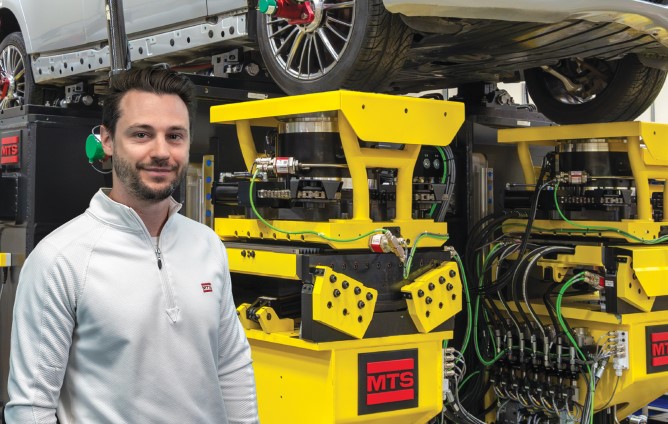
MTS offers a comprehensive portfolio of subsystem and full-vehicle test solutions supporting objective axle benchmarking. Dedicated fixtures enable precise loading of axle carriers, while kinematic and compliance systems quantify deflection and load paths under static and dynamic conditions. Tire-coupled and drivetrain test systems extend benchmarking to handling and torque-related behaviors. Advanced control, data acquisition, and repeatable laboratory environments ensure accurate, side-by-side comparison of competitor axle designs.
Test Methods
Vehicle axle subsystem benchmarking uses controlled laboratory tests to characterize structural stiffness, kinematic behavior, compliance, friction, and dynamic response under representative loads. Static and quasi-static deflection measurements apply vertical, lateral, and longitudinal forces to quantify compliance and load paths within axle carriers, joints, and mounting interfaces. Kinematic and compliance testing evaluates wheel center motion, bushing deformation, and load transfer characteristics. Dynamic methods introduce time-varying forces to assess frequency-dependent behavior, hysteresis, and durability-relevant responses. Handling and drivetrain-related benchmarking may include tire-coupled excitation or controlled torque application to examine axle response under cornering and power transmission conditions. These methods, defined by SAE-referenced practices, enable repeatable, side-by-side comparison of competitor designs under identical boundary conditions, providing objective mechanical performance data without the variability of on-road testing.
Test Results
Axle subsystem benchmarking results are used to compare stiffness, compliance, load transfer, and dynamic behavior across competitive designs. OEMs and suppliers apply these insights to identify performance gaps, guide design improvements, validate CAE models, and support make-versus-buy decisions while ensuring alignment with handling, durability, and NVH targets.
MTS Product Solutions
MTS offers a comprehensive portfolio of subsystem and full-vehicle test solutions supporting objective axle benchmarking. Dedicated fixtures enable precise loading of axle carriers, while kinematic and compliance systems quantify deflection and load paths under static and dynamic conditions. Tire-coupled and drivetrain test systems extend benchmarking to handling and torque-related behaviors. Advanced control, data acquisition, and repeatable laboratory environments ensure accurate, side-by-side comparison of competitor axle designs.
- Axle Carrier Fixtures (ACF) provide controlled, repeatable loading of axle carriers to measure stiffness, compliance, and load paths. It enables precise benchmarking of competitor axle architectures by isolating mechanical behavior under realistic boundary conditions.
- Kinematic & Compliance (K&C) Deflection Measurement Systems apply static and quasi-static loads to quantify axle kinematics, bushing compliance, and wheel center motion. They support direct comparison of competitor designs by delivering high-resolution displacement and force data.
- Dynamic Kinematic & Compliance (K&C) Systems extend benchmarking into time-varying load conditions, capturing frequency-dependent stiffness, hysteresis, and load transfer behavior. These measurements help engineers evaluate how axle subsystems respond under real-world dynamic driving events.
- Flat-Trac Handling Roadways reproduce controlled cornering and lateral load conditions through tire-coupled excitation. It supports axle benchmarking by evaluating subsystem response, load transfer, and compliance effects during repeatable handling maneuvers.
- Transmission Test Systems apply controlled torque and speed profiles to drivetrain components, enabling benchmarking of axle and driveline interfaces. They support evaluation of torsional stiffness, efficiency, and durability-related mechanical behavior.
- FlexTest® Controllers deliver precise, synchronized control of multi-axis actuators during axle benchmarking tests. Their high-bandwidth performance ensures accurate force application, displacement control, and data acquisition across static and dynamic test methods.