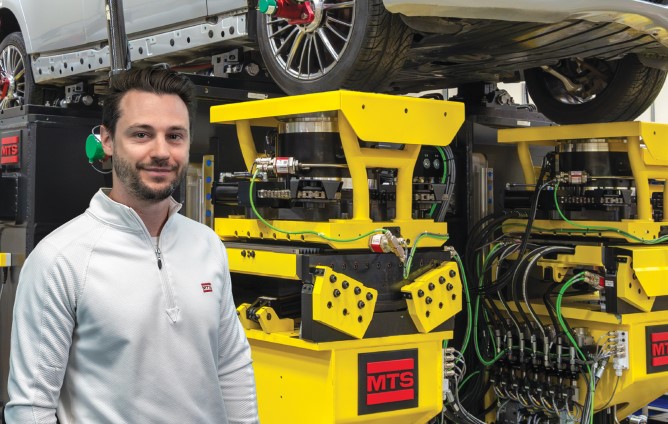
Full Vehicle Ride Comfort Assessment
Study vibrations and noise phenomena from road inputs to driver and occupant contact points to characterize the comfort of a vehicle.
Assessing full-vehicle ride comfort is essential for ensuring that road-induced vibrations and noise reaching occupants meet industry expectations for refinement, ergonomics and perceived quality. OEMs, tier-one suppliers, proving grounds and advanced research institutions conduct these evaluations to characterize vertical, lateral and longitudinal vibration paths and optimize suspensions, body structures, seats and isolation systems. Thorough ride comfort assessment helps teams tune vehicles for competitive market positioning and comply with global ride quality and noise-vibration guidelines.
Test Methods
Full-vehicle ride comfort assessment relies on standardized procedures to measure how road-induced vibrations propagate to occupants. Global standards define methods for vertical, lateral, and longitudinal vibration evaluation, including low-frequency ride assessment, impact harshness, and vibration transmissibility. Tests combine controlled laboratory simulations with structured proving-ground measurements. Tire-coupled road simulators and roadway systems reproduce cleats, potholes, and uneven surfaces while capturing suspension, body, and seat responses. Multi-axis excitation and frequency-domain analysis quantify modal and dynamic behaviors. Hybrid simulation integrates physical components, such as dampers or steering assemblies, with real-time vehicle models to assess comfort-critical interactions under representative road conditions. Data is collected for vibration, displacement, and force at key points, enabling correlation with CAE models, subsystem optimization, and repeatable evaluation of occupant comfort under diverse operating and road scenarios.
Test Results
Ride comfort data helps engineers refine the suspension, tires, seats and body isolation systems to improve occupant comfort, reduce fatigue and enhance perceived vehicle quality. Manufacturers and research facilities use these insights to benchmark competitive vehicles, validate design changes, guide chassis tuning and ensure compliance with global ride-comfort expectations. Data also supports correlation between simulation models and physical testing.
MTS Product Solutions
MTS delivers a comprehensive portfolio for full-vehicle ride comfort evaluation, offering highly repeatable road-input reproduction and unmatched control precision. Model 320 Road Simulators, Flat-Trac Comfort and Handling Roadways, and mHIL hybrid simulation solutions enable detailed characterization of vibration pathways and response behaviors. FlexTest® controllers, hydraulic service manifolds and SilentFlo™ HPUs provide reliable, responsive system performance that supports accurate low-frequency ride evaluation and advanced comfort development programs.
Test Methods
Full-vehicle ride comfort assessment relies on standardized procedures to measure how road-induced vibrations propagate to occupants. Global standards define methods for vertical, lateral, and longitudinal vibration evaluation, including low-frequency ride assessment, impact harshness, and vibration transmissibility. Tests combine controlled laboratory simulations with structured proving-ground measurements. Tire-coupled road simulators and roadway systems reproduce cleats, potholes, and uneven surfaces while capturing suspension, body, and seat responses. Multi-axis excitation and frequency-domain analysis quantify modal and dynamic behaviors. Hybrid simulation integrates physical components, such as dampers or steering assemblies, with real-time vehicle models to assess comfort-critical interactions under representative road conditions. Data is collected for vibration, displacement, and force at key points, enabling correlation with CAE models, subsystem optimization, and repeatable evaluation of occupant comfort under diverse operating and road scenarios.
Test Results
Ride comfort data helps engineers refine the suspension, tires, seats and body isolation systems to improve occupant comfort, reduce fatigue and enhance perceived vehicle quality. Manufacturers and research facilities use these insights to benchmark competitive vehicles, validate design changes, guide chassis tuning and ensure compliance with global ride-comfort expectations. Data also supports correlation between simulation models and physical testing.
MTS Product Solutions
MTS delivers a comprehensive portfolio for full-vehicle ride comfort evaluation, offering highly repeatable road-input reproduction and unmatched control precision. Model 320 Road Simulators, Flat-Trac Comfort and Handling Roadways, and mHIL hybrid simulation solutions enable detailed characterization of vibration pathways and response behaviors. FlexTest® controllers, hydraulic service manifolds and SilentFlo™ HPUs provide reliable, responsive system performance that supports accurate low-frequency ride evaluation and advanced comfort development programs.
- Model 320 Tire-Coupled Road Simulators reproduce real-world road profiles through the tire patch, enabling controlled evaluation of vertical, longitudinal and lateral ride inputs. It delivers high-fidelity excitation for assessing vehicle vibration pathways, impact harshness and comfort-related suspension characteristics.
- Flat-Trac Comfort Roadways generate precise, low-frequency road inputs and broadband excitations to evaluate full-vehicle vibration responses. They enable consistent reproduction of rough-road events, allowing engineers to tune chassis, isolation systems and seating for optimal occupant comfort.
- Flat-Trac Handling Roadways apply combined vertical and lateral loading to understand how handling-related dynamics influence ride comfort. It helps engineers evaluate tradeoffs between agility and refinement, supporting balanced chassis tuning across a wide operating envelope.
- Hybrid Simulation: mHIL Steer integrates physical steering hardware with real-time vehicle models to study how steering-system dynamics affect ride comfort. It enables precise assessment of shimmy, nibble and road-induced steering disturbances without requiring complete physical prototypes.
- Hybrid Simulation: mHIL Damper couples physical damper assemblies with virtual vehicle models to evaluate comfort-critical damping characteristics under realistic road excitations. It accelerates ride optimization by reducing prototype requirements and supporting early-stage refinement of suspension behavior.
- FlexTest Controllers deliver precise, real-time control of multi-axis ride comfort tests, ensuring accurate reproduction of road events and consistent measurement of low-frequency vibrations. Their responsiveness and configurability enhance fidelity across simulators and hybrid simulation environments.
- Series 295 Hydraulic Service Manifolds provide stable, responsive hydraulic distribution to ride comfort test systems, improving control accuracy and system reliability. Their robust, high-flow design ensures consistent performance during low-frequency and transient road-input reproduction.
- SilentFlo 515 & 525 HPUs supply clean, quiet, energy-efficient hydraulic power for ride comfort testing, minimizing background noise that can affect acoustic and vibration measurements. Their low-pulsation output supports high-fidelity control of road simulators and hybrid test rigs.