Full Vehicle Drivability
Gain subjective driver assessment of the smoothness and steadiness of vehicle acceleration under various driver, road and vehicle conditions.
Assessing full vehicle drivability is essential for understanding how smoothly and predictably a vehicle responds to driver inputs under varying load, speed, and road conditions. Automakers, proving grounds, and powertrain development teams use drivability evaluations to refine throttle response, torque delivery, and shift quality. These assessments help ensure a consistent, comfortable, and confidence-inspiring driving experience that aligns with customer expectations and regulatory demands.
Test Methods
Drivability is typically assessed through a combination of controlled laboratory evaluations and on-road tests that quantify vehicle response to acceleration, deceleration, torque transitions, load changes, and grade variations. Engineers use standardized drive cycles, transient maneuvers, and steady-state conditions to evaluate jerk, lag, hesitation, torque oscillation, and pedal progression. Global standards help define measurement protocols, ensuring consistent evaluation of powertrain and vehicle response. Moving belt dynamometers and roadway systems support these methods by providing a repeatable, torque-controlled environment where wheel forces, slip ratio, and longitudinal load can be precisely simulated. These systems enable detailed characterization of traction management, acceleration smoothness, electric drive responsiveness, and shift feel, allowing drivability evaluations without reliance on variable road conditions.
Test Results
Drivability assessment data helps manufacturers optimize torque delivery, refinement, and responsiveness across internal-combustion, hybrid, and battery-electric platforms. Development teams use these results to tune shift schedules, pedal mapping, launch behavior, and transient response. Research institutions apply the data to validate new control algorithms, benchmark competitive vehicles, and support advanced propulsion system innovations.
MTS Product Solutions
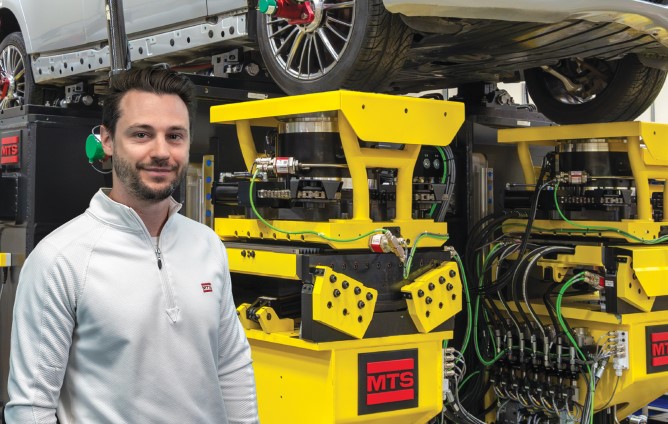
MTS drivability solutions combine high-fidelity Flat-Trac® Roadway technologies with precise FlexTest® control architectures to create stable, repeatable environments for evaluating longitudinal and torque-based performance. These systems deliver accurate wheel loading, slip control, and torque application across a wide speed range, enabling engineers to quantify acceleration smoothness, traction interventions, and propulsion system transitions. With robust hydraulics and advanced motion control, MTS platforms support drivability development for ICE, hybrid, and EV architectures.
Test Methods
Drivability is typically assessed through a combination of controlled laboratory evaluations and on-road tests that quantify vehicle response to acceleration, deceleration, torque transitions, load changes, and grade variations. Engineers use standardized drive cycles, transient maneuvers, and steady-state conditions to evaluate jerk, lag, hesitation, torque oscillation, and pedal progression. Global standards help define measurement protocols, ensuring consistent evaluation of powertrain and vehicle response. Moving belt dynamometers and roadway systems support these methods by providing a repeatable, torque-controlled environment where wheel forces, slip ratio, and longitudinal load can be precisely simulated. These systems enable detailed characterization of traction management, acceleration smoothness, electric drive responsiveness, and shift feel, allowing drivability evaluations without reliance on variable road conditions.
Test Results
Drivability assessment data helps manufacturers optimize torque delivery, refinement, and responsiveness across internal-combustion, hybrid, and battery-electric platforms. Development teams use these results to tune shift schedules, pedal mapping, launch behavior, and transient response. Research institutions apply the data to validate new control algorithms, benchmark competitive vehicles, and support advanced propulsion system innovations.
MTS Product Solutions
MTS drivability solutions combine high-fidelity Flat-Trac® Roadway technologies with precise FlexTest® control architectures to create stable, repeatable environments for evaluating longitudinal and torque-based performance. These systems deliver accurate wheel loading, slip control, and torque application across a wide speed range, enabling engineers to quantify acceleration smoothness, traction interventions, and propulsion system transitions. With robust hydraulics and advanced motion control, MTS platforms support drivability development for ICE, hybrid, and EV architectures.
- Flat-Trac Dynamometer Roadways apply precise rolling resistance, longitudinal loading, and torque control to replicate real driving conditions in the lab. They enable evaluation of acceleration smoothness, propulsion transitions, and traction functions under controlled and repeatable scenarios.
- Flat-Trac Comfort Roadways replicate low-frequency inputs, ride-induced torque disturbances, and subtle surface variations. They allow engineers to assess driveline sensitivity, pedal smoothness, and torque oscillations that influence overall drivability and cabin refinement.
- The Flat-Trac Handling Roadway delivers controlled slip angle and lateral force capability, allowing evaluation of drivability during combined-maneuver acceleration, corner exit torque application, and traction management events that influence vehicle responsiveness.
- FlexTest Controllers provide deterministic, high-bandwidth control of roadway actuators, ensuring accurate reproduction of torque transitions, acceleration profiles, and transient drivability events. Their precision supports consistent evaluation of powertrain response across repeated tests.
- Series 295 Hydraulic Service Manifolds deliver stable hydraulic flow and pressure management to Flat-Trac systems, supporting high-fidelity roadway control. Their reliability ensures consistent actuator response crucial for sensitive drivability assessments.
- SilentFlo™ 515 & 525 Hydraulic Power Units supply clean, stable hydraulic power with low acoustic emissions, helping maintain consistent control accuracy during drivability evaluations. Their efficiency and quiet operation enhance test repeatability and operator comfort.