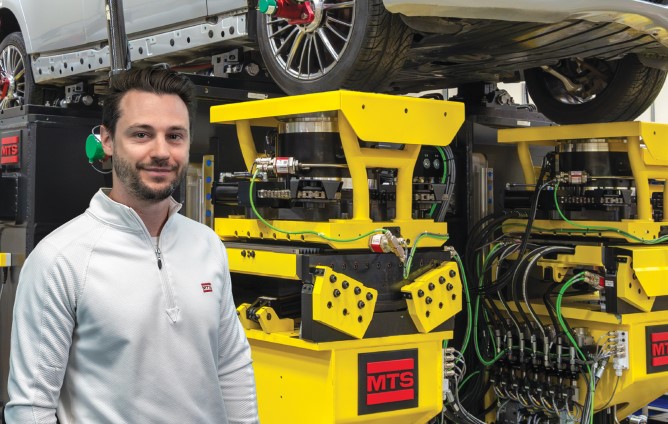
Axle / Suspension Subsystem Characterization
Study characteristics of interest (performance, modal, transmissibility, stiffness, etc.) of axle components such as springs, dampers and anti-roll bars.
Characterizing axle and suspension subsystems is essential for understanding how components such as springs, dampers, stabilizer bars, and bushings contribute to vehicle performance, handling, and NVH behavior. OEMs, tier-one suppliers, research institutions, and test labs perform these evaluations to quantify subsystem stiffness, damping, and dynamic responses. The resulting data guides component selection, validates simulation models, and ensures that axles and suspension assemblies perform predictably under real-world loads, supporting optimization of ride quality, handling, and overall vehicle dynamics.
Test Methods
Axle and suspension subsystem characterization employs multi-axis displacement, force, and torque inputs to quantify stiffness, damping, modal response, and load transmissibility of springs, dampers, bushings, and stabilizer bars. Global standards specify procedures for spring-rate measurement, damper force-velocity profiling, anti-roll bar torsional stiffness, and bushing compliance under both static and dynamic conditions. Tests utilize controlled frequency sweeps, random or transient excitations, and hybrid methods to replicate realistic road loads and vehicle motions. Subsystems are mounted in configurable fixtures that replicate in-vehicle boundary conditions while actuators apply precise multi-axis forces and motions. Data acquisition captures deflection, force, torque, and vibration to evaluate subsystem behavior comprehensively. These methods enable engineers to identify nonlinearity, validate CAE models, correlate results with proving-ground or track data, and quantify contributions of individual components to ride, handling, and NVH performance.
Test Results
Characterization data informs engineers on axle and suspension subsystem behavior under operational loads. OEMs, suppliers, and research labs use the results to refine component stiffness, damping, and modal properties, validate CAE models, and optimize ride, handling, and NVH. The data also supports subsystem-level improvements before integration into full-vehicle testing, ensuring predictable and repeatable dynamic performance.
MTS Product Solutions
MTS provides a versatile portfolio for axle and suspension characterization, combining high-precision actuation, flexible fixtures, and advanced control. The Axle Carrier Fixture (ACF) can be deployed with K&C, Dynamic K&C, or Flat-Trac Handling Roadway systems to replicate in-vehicle constraints. FlexTest® controllers aenable precise, multi-axis load application, while high-fidelity measurement and data acquisition support repeatable evaluation of stiffness, damping, modal behavior, and subsystem interactions under laboratory-controlled conditions.
Test Methods
Axle and suspension subsystem characterization employs multi-axis displacement, force, and torque inputs to quantify stiffness, damping, modal response, and load transmissibility of springs, dampers, bushings, and stabilizer bars. Global standards specify procedures for spring-rate measurement, damper force-velocity profiling, anti-roll bar torsional stiffness, and bushing compliance under both static and dynamic conditions. Tests utilize controlled frequency sweeps, random or transient excitations, and hybrid methods to replicate realistic road loads and vehicle motions. Subsystems are mounted in configurable fixtures that replicate in-vehicle boundary conditions while actuators apply precise multi-axis forces and motions. Data acquisition captures deflection, force, torque, and vibration to evaluate subsystem behavior comprehensively. These methods enable engineers to identify nonlinearity, validate CAE models, correlate results with proving-ground or track data, and quantify contributions of individual components to ride, handling, and NVH performance.
Test Results
Characterization data informs engineers on axle and suspension subsystem behavior under operational loads. OEMs, suppliers, and research labs use the results to refine component stiffness, damping, and modal properties, validate CAE models, and optimize ride, handling, and NVH. The data also supports subsystem-level improvements before integration into full-vehicle testing, ensuring predictable and repeatable dynamic performance.
MTS Product Solutions
MTS provides a versatile portfolio for axle and suspension characterization, combining high-precision actuation, flexible fixtures, and advanced control. The Axle Carrier Fixture (ACF) can be deployed with K&C, Dynamic K&C, or Flat-Trac Handling Roadway systems to replicate in-vehicle constraints. FlexTest® controllers aenable precise, multi-axis load application, while high-fidelity measurement and data acquisition support repeatable evaluation of stiffness, damping, modal behavior, and subsystem interactions under laboratory-controlled conditions.
- FlexTest Controllers provide high-bandwidth, multichannel control for axle and suspension characterization, enabling accurate execution of stiffness, damping, and modal test profiles. They ensure repeatable, stable actuation across static, dynamic, and hybrid test modes.
- Axle Carrier Fixtures (ACF) create a vehicle-representative mounting structure for axles and suspension subsystems. Deployable with K&C, Dynamic K&C, or Flat-Trac Handling Roadway, it provides rigid, configurable interfaces to capture accurate deflection, stiffness, and modal responses under realistic boundary conditions.
- Kinematic & Compliance (K&C) Deflection Measurement Systems measure multi-axis deflection and compliance of axle and suspension subsystems under static and quasi-static loads. Paired with the ACF, they provide precise stiffness and alignment data to correlate with simulation and support suspension tuning.
- Dynamic Kinematic & Compliance (K&C) Systems add time-varying excitation to measure subsystem behavior under operationally realistic, frequency-dependent loads. These tests enable engineers to quantify damping, dynamic compliance, and load transmissibility of axles and associated suspension components.
- Flat-Trac Handling Roadways allow high-fidelity simulation of vehicle cornering, steering, and transient maneuvers. When combined with the ACF, engineers can evaluate axle and suspension subsystem contributions to handling, roll stiffness, and NVH in a controlled laboratory environment.