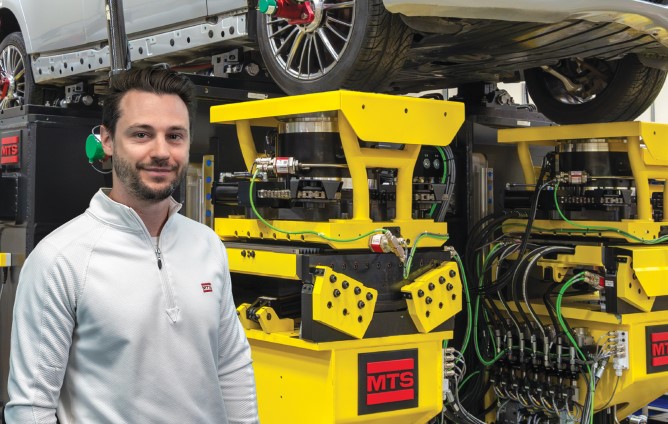
Steering System Set-up, Tuning & Evaluation
Perform steering system set-up, tuning and vehicle-level evaluation with only a subsystem of parts in a laboratory environment.
Performing steering system set-up and tuning using only the steering subsystem allows engineers to evaluate vehicle-level steering behavior without a complete vehicle prototype. By combining physical steering hardware with pre-recorded road loads or digital driving environments, OEMs, suppliers, and research organizations can assess steering feel, response, and stability earlier in development. This hybrid simulation approach accelerates calibration, improves model accuracy, reduces cost and risk, and supports confident steering design decisions before track testing.
Test Methods
Steering system hybrid simulation combines physical steering hardware with real-time numerical vehicle and road models to reproduce realistic driving maneuvers in a laboratory environment. Steering torque, angle, and rack forces are exchanged continuously between the hardware under test and the virtual vehicle, enabling evaluation of on-center behavior, steering response, assist characteristics, and transient handling events. Pre-recorded proving-ground data or synthetic road environments define steering inputs and vehicle states, while controlled actuation applies corresponding loads and motions. This mechanical hardware-in-the-loop methodology supports repeatable assessment of steering performance during maneuvers such as lane changes, cornering, and disturbance rejection. SAE-aligned hybrid simulation practices define requirements for real-time synchronization, stability, and correlation, ensuring credible representation of vehicle-level steering behavior.
Test Results
Steering hybrid simulation results quantify steering effort, response, assist behavior, and transient performance during real-world maneuvers. Manufacturers, test laboratories, and research institutions use this data to tune steering systems, validate CAE models, evaluate design variants, and reduce reliance on late-stage vehicle prototypes and track testing.
MTS Product Solutions
MTS provides hybrid simulation solutions that enable mechanical hardware-in-the-loop evaluation of steering systems at a vehicle level. Dedicated steering test systems interface with real-time digital vehicle environments, while advanced control ensures stable, synchronized force and motion feedback. This portfolio supports early steering calibration, objective comparison of design variants, and safe evaluation of normal and fault conditions—accelerating development while reducing prototype and track dependency.
Test Methods
Steering system hybrid simulation combines physical steering hardware with real-time numerical vehicle and road models to reproduce realistic driving maneuvers in a laboratory environment. Steering torque, angle, and rack forces are exchanged continuously between the hardware under test and the virtual vehicle, enabling evaluation of on-center behavior, steering response, assist characteristics, and transient handling events. Pre-recorded proving-ground data or synthetic road environments define steering inputs and vehicle states, while controlled actuation applies corresponding loads and motions. This mechanical hardware-in-the-loop methodology supports repeatable assessment of steering performance during maneuvers such as lane changes, cornering, and disturbance rejection. SAE-aligned hybrid simulation practices define requirements for real-time synchronization, stability, and correlation, ensuring credible representation of vehicle-level steering behavior.
Test Results
Steering hybrid simulation results quantify steering effort, response, assist behavior, and transient performance during real-world maneuvers. Manufacturers, test laboratories, and research institutions use this data to tune steering systems, validate CAE models, evaluate design variants, and reduce reliance on late-stage vehicle prototypes and track testing.
MTS Product Solutions
MTS provides hybrid simulation solutions that enable mechanical hardware-in-the-loop evaluation of steering systems at a vehicle level. Dedicated steering test systems interface with real-time digital vehicle environments, while advanced control ensures stable, synchronized force and motion feedback. This portfolio supports early steering calibration, objective comparison of design variants, and safe evaluation of normal and fault conditions—accelerating development while reducing prototype and track dependency.
- Hybrid Simulation: mHIL Steer combines physical steering systems with real-time vehicle and road models to enable vehicle-level steering evaluation in the lab. It supports early tuning, realistic maneuver simulation, and improved correlation without full vehicle prototypes.
- Electric & Hydraulic Power Steering Test Systems apply controlled torque, angle, and load profiles to electric and hydraulic steering hardware. They enable detailed evaluation of assist characteristics, friction, and response during hybrid simulation of real-world driving maneuvers.
- FlexTest® Controllers provide deterministic, high-bandwidth control required for stable steering hardware-in-the-loop simulation. Their real-time performance ensures accurate force feedback, synchronization, and safe operation during complex steering evaluations.