Advanced Vehicle Dynamics R&D
Set-up, tune, evaluate, validate and certify new or unique vehicle technologies such as ADAS, AV, active safety and stability systems.
Advanced Vehicle Dynamics R&D is critical for setting up, tuning, evaluating, validating, and certifying emerging vehicle technologies such as ADAS, automated driving, active safety, and stability systems. Full-vehicle testing captures the coupled behavior of tires, chassis, and control algorithms under realistic dynamic conditions that cannot be fully resolved through simulation alone. This work is typically performed by OEM vehicle dynamics teams, Tier 1 suppliers, proving-ground organizations, and academic or government research laboratories supporting safety validation and regulatory compliance.
Test Methods
Advanced vehicle dynamics evaluation follows SAE and ISO practices that define how handling, stability, and control-system behavior are assessed under controlled conditions. These methods require repeatable tire–road interaction to evaluate lateral force generation, yaw response, steering sensitivity, and intervention thresholds of active safety systems. Full vehicles are exercised through maneuvers such as steady-state cornering, step steer, sine-with-dwell, and lane-change tests while measuring tire forces, moments, wheel motions, body accelerations, and control-system outputs. Laboratory handling roadways reproduce these maneuvers by applying precise lateral, longitudinal, and vertical inputs at the tire interface. The resulting repeatability enables safe exploration of limit behavior, consistent tuning of stability and steering algorithms, and reliable correlation with simulation and proving-ground results.
Test Results
Advanced vehicle dynamics test results are used to tune chassis hardware and control algorithms, validate ADAS and stability-system performance, and demonstrate predictable vehicle behavior near handling limits. OEMs, suppliers, and research organizations use these data to benchmark vehicles, correlate simulation models, refine control strategies, and support safety certification and production readiness.
MTS Product Solutions
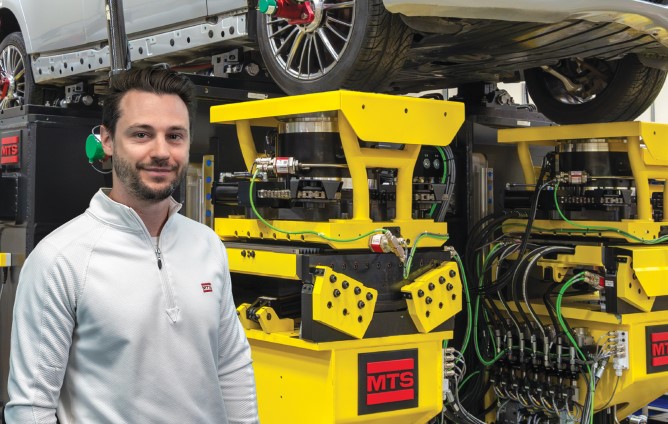
MTS provides specialized solutions for advanced vehicle dynamics development through high-fidelity handling roadways and deterministic control technology. Flat-Trac® Handling Roadways deliver precise, repeatable tire–road interaction essential for limit-handling and stability evaluations, while FlexTest® controllers provide synchronized multichannel control. Together, they enable confident tuning, validation, and certification of advanced vehicle dynamics and active safety systems under controlled laboratory conditions.
Test Methods
Advanced vehicle dynamics evaluation follows SAE and ISO practices that define how handling, stability, and control-system behavior are assessed under controlled conditions. These methods require repeatable tire–road interaction to evaluate lateral force generation, yaw response, steering sensitivity, and intervention thresholds of active safety systems. Full vehicles are exercised through maneuvers such as steady-state cornering, step steer, sine-with-dwell, and lane-change tests while measuring tire forces, moments, wheel motions, body accelerations, and control-system outputs. Laboratory handling roadways reproduce these maneuvers by applying precise lateral, longitudinal, and vertical inputs at the tire interface. The resulting repeatability enables safe exploration of limit behavior, consistent tuning of stability and steering algorithms, and reliable correlation with simulation and proving-ground results.
Test Results
Advanced vehicle dynamics test results are used to tune chassis hardware and control algorithms, validate ADAS and stability-system performance, and demonstrate predictable vehicle behavior near handling limits. OEMs, suppliers, and research organizations use these data to benchmark vehicles, correlate simulation models, refine control strategies, and support safety certification and production readiness.
MTS Product Solutions
MTS provides specialized solutions for advanced vehicle dynamics development through high-fidelity handling roadways and deterministic control technology. Flat-Trac® Handling Roadways deliver precise, repeatable tire–road interaction essential for limit-handling and stability evaluations, while FlexTest® controllers provide synchronized multichannel control. Together, they enable confident tuning, validation, and certification of advanced vehicle dynamics and active safety systems under controlled laboratory conditions.
- Flat-Trac Handling Roadways reproduce realistic lateral and longitudinal tire forces with exceptional repeatability, enabling controlled execution of aggressive handling maneuvers. They support tuning and validation of steering response, electronic stability control, torque vectoring, and automated driving functions on full vehicles.
- FlexTest Controllers provide high-bandwidth, deterministic multichannel control for vehicle dynamics testing. Their precise synchronization and real-time performance ensure accurate execution of handling maneuvers and stable interaction with steering, braking, and active safety control systems.