Full Vehicle Rollover Propensity
Determine the lateral acceleration threshold at the point of vehicle tire lift-off from the ground.
Rollover propensity results are used to quantify wheel lift thresholds, lateral load transfer behavior, and suspension contributions to vehicle stability. OEMs, test laboratories, and research institutions apply this data to refine suspension tuning, calibrate stability control systems, validate simulation models, and demonstrate compliance with global safety and regulatory requirements.
Test Methods
Rollover propensity evaluation involves subjecting vehicles to controlled lateral accelerations that simulate aggressive cornering and transient handling maneuvers, while monitoring wheel loads, suspension motion, body roll, and tire lift-off. Laboratory methods replicate these conditions using either multi-axis kinematic and compliance test systems or tire-coupled handling roadways, depending on test objectives. Kinematic and compliance approaches apply precisely controlled forces and moments at each wheel to quantify load transfer, roll stiffness, and suspension behavior leading to wheel lift. Handling roadways reproduce dynamic lateral maneuvers through driven tire inputs, enabling observation of vehicle response under realistic cornering conditions. Both approaches provide repeatable, instrumented alternatives to proving-ground testing, supporting systematic evaluation of rollover thresholds, center-of-gravity effects, and stability control strategies.
Test Results
Rollover propensity results are used to quantify wheel lift thresholds, lateral load transfer behavior, and suspension contributions to vehicle stability. OEMs, test laboratories, and research institutions apply this data to refine suspension tuning, calibrate stability control systems, validate simulation models, and demonstrate compliance with global safety and regulatory requirements.
MTS Product Solutions
MTS offers multiple laboratory-based solutions for evaluating full-vehicle rollover propensity, enabling safe, repeatable assessment of extreme lateral dynamics. Dynamic Kinematic & Compliance systems support detailed measurement of suspension motion and load transfer leading to tire lift-off, while Flat-Trac® Handling Roadways reproduce aggressive cornering maneuvers through tire-coupled excitation. Together with advanced control and data acquisition technologies, these solutions allow engineers to characterize rollover behavior without the variability and risk of on-road testing.
Test Methods
Rollover propensity evaluation involves subjecting vehicles to controlled lateral accelerations that simulate aggressive cornering and transient handling maneuvers, while monitoring wheel loads, suspension motion, body roll, and tire lift-off. Laboratory methods replicate these conditions using either multi-axis kinematic and compliance test systems or tire-coupled handling roadways, depending on test objectives. Kinematic and compliance approaches apply precisely controlled forces and moments at each wheel to quantify load transfer, roll stiffness, and suspension behavior leading to wheel lift. Handling roadways reproduce dynamic lateral maneuvers through driven tire inputs, enabling observation of vehicle response under realistic cornering conditions. Both approaches provide repeatable, instrumented alternatives to proving-ground testing, supporting systematic evaluation of rollover thresholds, center-of-gravity effects, and stability control strategies.
Test Results
Rollover propensity results are used to quantify wheel lift thresholds, lateral load transfer behavior, and suspension contributions to vehicle stability. OEMs, test laboratories, and research institutions apply this data to refine suspension tuning, calibrate stability control systems, validate simulation models, and demonstrate compliance with global safety and regulatory requirements.
MTS Product Solutions
MTS offers multiple laboratory-based solutions for evaluating full-vehicle rollover propensity, enabling safe, repeatable assessment of extreme lateral dynamics. Dynamic Kinematic & Compliance systems support detailed measurement of suspension motion and load transfer leading to tire lift-off, while Flat-Trac® Handling Roadways reproduce aggressive cornering maneuvers through tire-coupled excitation. Together with advanced control and data acquisition technologies, these solutions allow engineers to characterize rollover behavior without the variability and risk of on-road testing.
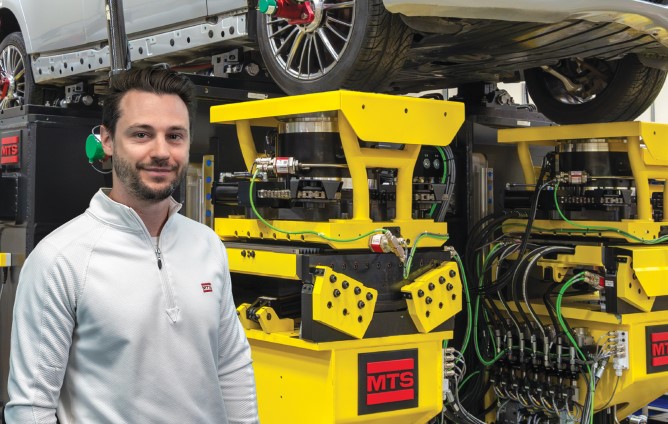
- Dynamic Kinematic & Compliance (K&C) Systems apply controlled forces and moments at each wheel to measure suspension kinematics, compliance, and lateral load transfer. They enable precise determination of tire lift-off thresholds and support detailed analysis of rollover-related suspension behavior.
- The Flat-Trac Handling Roadway reproduces high-lateral-acceleration cornering maneuvers using tire-coupled excitation. It allows engineers to safely evaluate rollover propensity, wheel unloading, and vehicle roll response under realistic, repeatable laboratory conditions.
- FlexTest® Controllers deliver synchronized, high-bandwidth control of actuators and sensors during rollover testing. Their precise closed-loop performance ensures accurate force application, motion control, and data acquisition under extreme lateral loading scenarios.