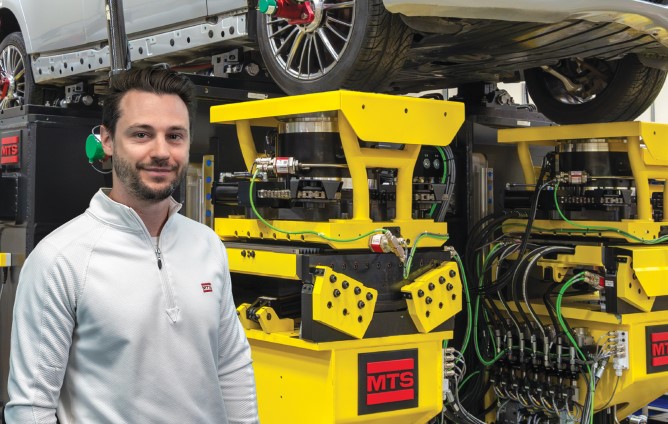
Center of Gravity & Vehicle Inertia Measurement
Gain measurements of vehicle Center of Gravity (CG) and inertia characteristics used to study and/or confirm vehicle properties.
Accurate measurement of full-vehicle center of gravity and inertia properties is critical for predicting handling balance, braking stability, rollover propensity, and overall vehicle dynamic behavior. These parameters form the foundation of chassis simulation models used throughout vehicle development and validation. Automotive OEMs, tier-one suppliers, proving grounds, and research institutions conduct CG and inertia measurements to confirm design intent, support model correlation, and ensure vehicle safety and performance targets are achieved across platforms and variants.
Test Methods
Industry methods for determining vehicle center of gravity and inertia characteristics are defined by established SAE and ISO practices and are commonly performed using laboratory-based kinematic and compliance test systems. These methods apply controlled forces and moments at the wheels or suspension interfaces while precisely measuring resulting displacements, rotations, and load redistribution. Static and quasi-static load application is used to calculate longitudinal, lateral, and vertical CG location based on axle load transfer and suspension geometry. Dynamic techniques introduce low-frequency, multi-axis excitation to the vehicle body, allowing mass moments of inertia about roll, pitch, and yaw axes to be derived from measured force–motion relationships. High-stiffness fixturing, synchronized multi-channel control, and high-resolution displacement measurement are essential to ensure repeatable boundary conditions and accurate characterization of full-vehicle mass properties.
Test Results
Center of gravity and inertia measurement results are used to parameterize vehicle dynamics simulations, validate chassis models, and support handling and stability tuning. OEMs and test labs apply this data to assess rollover risk, braking performance, and transient response, while research organizations use results to improve correlation between physical testing and analytical models.
MTS Product Solutions
MTS provides dedicated full-vehicle test systems for accurate measurement of center of gravity and inertia characteristics using controlled laboratory methods. Kinematic & Compliance platforms enable precise application of forces and moments with high-fidelity motion measurement, while dynamic capabilities extend these measurements into inertia characterization. Advanced control, synchronized data acquisition, and robust mechanical architectures ensure repeatable results suitable for simulation correlation and vehicle dynamics development.
Test Methods
Industry methods for determining vehicle center of gravity and inertia characteristics are defined by established SAE and ISO practices and are commonly performed using laboratory-based kinematic and compliance test systems. These methods apply controlled forces and moments at the wheels or suspension interfaces while precisely measuring resulting displacements, rotations, and load redistribution. Static and quasi-static load application is used to calculate longitudinal, lateral, and vertical CG location based on axle load transfer and suspension geometry. Dynamic techniques introduce low-frequency, multi-axis excitation to the vehicle body, allowing mass moments of inertia about roll, pitch, and yaw axes to be derived from measured force–motion relationships. High-stiffness fixturing, synchronized multi-channel control, and high-resolution displacement measurement are essential to ensure repeatable boundary conditions and accurate characterization of full-vehicle mass properties.
Test Results
Center of gravity and inertia measurement results are used to parameterize vehicle dynamics simulations, validate chassis models, and support handling and stability tuning. OEMs and test labs apply this data to assess rollover risk, braking performance, and transient response, while research organizations use results to improve correlation between physical testing and analytical models.
MTS Product Solutions
MTS provides dedicated full-vehicle test systems for accurate measurement of center of gravity and inertia characteristics using controlled laboratory methods. Kinematic & Compliance platforms enable precise application of forces and moments with high-fidelity motion measurement, while dynamic capabilities extend these measurements into inertia characterization. Advanced control, synchronized data acquisition, and robust mechanical architectures ensure repeatable results suitable for simulation correlation and vehicle dynamics development.
- FlexTest® Controllers provide synchronized, multi-axis force and motion control required for full-vehicle CG and inertia measurement. High bandwidth, real-time computation, and stable closed-loop performance ensure precise load application and accurate capture of vehicle response data.
- Kinematic & Compliance (K&C) Deflection Measurement Systems apply controlled forces and moments at each wheel while measuring resulting displacements and rotations. This enables accurate calculation of vehicle center of gravity location and mass distribution under well-defined laboratory boundary conditions.
- Dynamic Kinematic & Compliance (K&C) Systems extend traditional measurements by applying low-frequency, multi-axis excitation to the full vehicle. These systems enable direct determination of mass moments of inertia while maintaining precise control of forces, motions, and test repeatability.