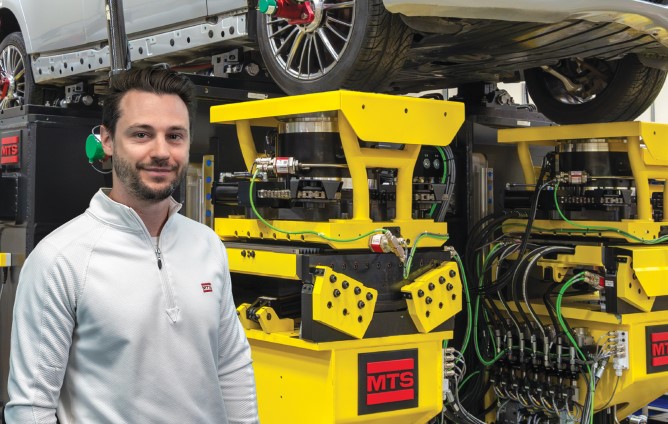
Elastomer Dynamic Characterization
Measure dynamic elastomer behavior in single or multiple axes.
Measuring the dynamic behavior of automotive elastomer components—such as engine mounts, bushings, and isolators—is essential for understanding how they respond to vibration, shock, and multi-axis loads. These evaluations ensure proper vibration isolation, ride comfort, and structural compatibility. OEM engineers, Tier 1 suppliers, and specialized test laboratories typically conduct dynamic characterization to validate component performance, refine designs, and support vehicle-level simulation models for both NVH and ride-quality optimization.
Test Methods
Dynamic characterization of elastomer components involves applying controlled oscillatory or transient loads in single or multiple axes to measure stiffness, damping, and energy dissipation properties. Testing includes sinusoidal, random, and sweep excitations to capture frequency-dependent behavior under representative operational conditions. Components such as engine mounts, bushings, and isolators are subjected to varying temperatures and preloads to simulate real-world service conditions. Laboratory systems provide precise, repeatable force or displacement control, enabling measurement of force-deflection relationships, hysteresis, and dynamic stiffness. Data acquisition tracks responses across frequency ranges, while specialized software allows automated sequence control, signal analysis, and visualization. These methods support correlation to vehicle-level dynamics, material formulation evaluation, and optimization of component performance for ride comfort and NVH reduction.
Test Results
Dynamic characterization results provide critical insight into stiffness, damping, and hysteresis properties of engine mounts, bushings, and isolators. Manufacturers and research labs use this data to refine material formulations, optimize component geometry, validate vehicle models, and ensure performance targets for vibration isolation and ride comfort are achieved.
MTS Product Solutions
MTS Elastomer Test Systems enable precise multi-axis dynamic testing of engine mounts, bushings, and vibration isolators. Coupled with MTS Elastomer Testing Software, they deliver automated control, real-time data acquisition, and analysis. These systems support accurate evaluation of stiffness, damping, and hysteresis properties, helping engineers optimize component design, ensure repeatability, and correlate laboratory data to vehicle-level dynamic performance.
Test Methods
Dynamic characterization of elastomer components involves applying controlled oscillatory or transient loads in single or multiple axes to measure stiffness, damping, and energy dissipation properties. Testing includes sinusoidal, random, and sweep excitations to capture frequency-dependent behavior under representative operational conditions. Components such as engine mounts, bushings, and isolators are subjected to varying temperatures and preloads to simulate real-world service conditions. Laboratory systems provide precise, repeatable force or displacement control, enabling measurement of force-deflection relationships, hysteresis, and dynamic stiffness. Data acquisition tracks responses across frequency ranges, while specialized software allows automated sequence control, signal analysis, and visualization. These methods support correlation to vehicle-level dynamics, material formulation evaluation, and optimization of component performance for ride comfort and NVH reduction.
Test Results
Dynamic characterization results provide critical insight into stiffness, damping, and hysteresis properties of engine mounts, bushings, and isolators. Manufacturers and research labs use this data to refine material formulations, optimize component geometry, validate vehicle models, and ensure performance targets for vibration isolation and ride comfort are achieved.
MTS Product Solutions
MTS Elastomer Test Systems enable precise multi-axis dynamic testing of engine mounts, bushings, and vibration isolators. Coupled with MTS Elastomer Testing Software, they deliver automated control, real-time data acquisition, and analysis. These systems support accurate evaluation of stiffness, damping, and hysteresis properties, helping engineers optimize component design, ensure repeatability, and correlate laboratory data to vehicle-level dynamic performance.
- FlexTest® Controllers provide deterministic, high-speed control for multi-axis elastomer dynamic testing. Their advanced algorithms and real-time computation ensure repeatable application of sinusoidal, random, and transient loads, supporting accurate characterization of stiffness, damping, and energy dissipation.
- Elastomer Test Systems apply controlled single- or multi-axis dynamic loads to engine mounts, bushings, and isolators. They measure frequency-dependent stiffness, damping, and hysteresis, enabling engineers to replicate service conditions and optimize material and component performance.
- MTS Elastomer Testing Software automates test execution, data acquisition, and analysis for dynamic characterization. It allows engineers to perform multi-frequency evaluations, visualize responses, and generate reports for correlation to vehicle-level vibration and NVH simulations.