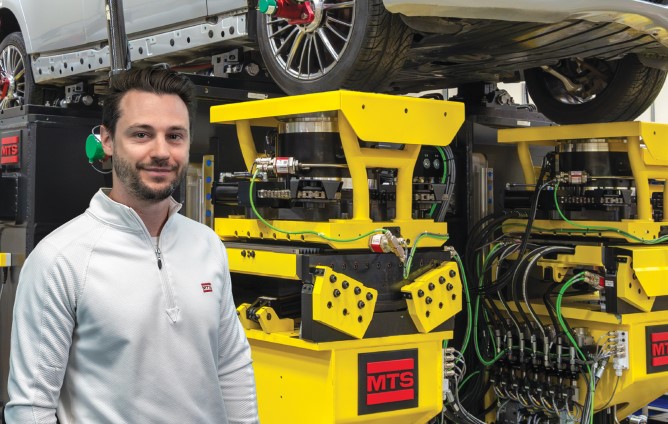
Full Vehicle Handling
Assess a vehicle’s driving attributes throughout a variety of standard and dynamic maneuvers, ranging from every-day driving up to limit handling.
Assessing full vehicle handling is critical for understanding how a vehicle responds to driver inputs and road conditions across everyday driving and limit-handling scenarios. These evaluations quantify steering response, stability, controllability, and overall vehicle balance, directly influencing safety and driver confidence. Full vehicle handling testing is performed by automotive OEMs, Tier 1 suppliers, independent test laboratories, and academic research institutions to support chassis development, validate simulation models, and ensure vehicles meet global performance expectations.
Test Methods
Full vehicle handling assessment methods are defined through global SAE, ISO, and OEM practices that codify standardized maneuvers and objective metrics. Common approaches include steady-state cornering, step steer, sine-with-dwell, and transient lane-change maneuvers used to evaluate lateral acceleration, yaw rate response, steering gain, and stability margins. In laboratory environments, these maneuvers are reproduced by applying precisely controlled lateral, longitudinal, and vertical forces at the tire–road interface, enabling repeatable simulation of cornering and transient events. Real-time test control synchronizes tire forces, wheel speeds, and steering inputs to capture coupled vehicle responses. Hybrid simulation techniques extend these methods by combining physical steering systems or dampers with real-time vehicle dynamics models, allowing engineers to study handling balance, transient response, and driver feel under controlled, repeatable conditions while reducing dependence on variable proving-ground testing.
Test Results
Full vehicle handling assessments provide objective measures of responsiveness, stability, and controllability. Manufacturers, test labs, and research institutions use these results to tune steering and suspension systems, validate vehicle dynamics models, benchmark competitive vehicles, and ensure consistent handling performance across platforms and operating conditions.
MTS Product Solutions
MTS offers an integrated portfolio for assessing full vehicle handling in controlled laboratory environments. Flat-Trac® handling and rolling-road systems reproduce realistic tire forces and motions with high repeatability, while Model 320 road simulators apply road-representative wheel loads. Hybrid simulation solutions integrate physical steering and damping subsystems with real-time vehicle models, and FlexTest® controllers provide the high-bandwidth, deterministic control needed for accurate, repeatable handling evaluations.
Test Methods
Full vehicle handling assessment methods are defined through global SAE, ISO, and OEM practices that codify standardized maneuvers and objective metrics. Common approaches include steady-state cornering, step steer, sine-with-dwell, and transient lane-change maneuvers used to evaluate lateral acceleration, yaw rate response, steering gain, and stability margins. In laboratory environments, these maneuvers are reproduced by applying precisely controlled lateral, longitudinal, and vertical forces at the tire–road interface, enabling repeatable simulation of cornering and transient events. Real-time test control synchronizes tire forces, wheel speeds, and steering inputs to capture coupled vehicle responses. Hybrid simulation techniques extend these methods by combining physical steering systems or dampers with real-time vehicle dynamics models, allowing engineers to study handling balance, transient response, and driver feel under controlled, repeatable conditions while reducing dependence on variable proving-ground testing.
Test Results
Full vehicle handling assessments provide objective measures of responsiveness, stability, and controllability. Manufacturers, test labs, and research institutions use these results to tune steering and suspension systems, validate vehicle dynamics models, benchmark competitive vehicles, and ensure consistent handling performance across platforms and operating conditions.
MTS Product Solutions
MTS offers an integrated portfolio for assessing full vehicle handling in controlled laboratory environments. Flat-Trac® handling and rolling-road systems reproduce realistic tire forces and motions with high repeatability, while Model 320 road simulators apply road-representative wheel loads. Hybrid simulation solutions integrate physical steering and damping subsystems with real-time vehicle models, and FlexTest® controllers provide the high-bandwidth, deterministic control needed for accurate, repeatable handling evaluations.
- FlexTest Controllers deliver deterministic, high-speed multi-axis control for full vehicle handling and hybrid simulation testing. Real-time computation, advanced control algorithms, and a scalable architecture ensures precise coordination of steering, tire forces, and suspension responses.
- Flat-Trac Handling Roadways generate controlled lateral, longitudinal, and vertical tire forces to replicate cornering and transient handling maneuvers. They enable highly repeatable laboratory evaluation of steering response, stability limits, and overall vehicle balance.
- Model 320 Tire-Coupled Road Simulators apply realistic wheel loads and motions through the tires, supporting full vehicle handling studies. Their controlled excitation allows engineers to evaluate vehicle response under repeatable, road-representative conditions.
- Flat-Trac Rolling Road Systems provide continuous flat-belt tire support for dynamic vehicle testing. They enable accurate assessment of steering response, yaw behavior, and lateral dynamics during handling evaluations conducted in laboratory environments.
- Flat-Trac Dynamometer Roadways combine flat-belt tire support with precise speed and load control. This configuration supports handling assessments under driven-wheel conditions, enabling evaluation of traction effects and vehicle response during dynamic maneuvers.
- Hybrid Simulation: mHIL Steer integrates physical steering systems with real-time vehicle dynamics models to evaluate steering response and driver feel. This hybrid approach enables early, repeatable handling assessments without requiring complete vehicle prototypes.
- Hybrid Simulation: mHIL Damper combines physical dampers with real-time vehicle simulations to study damping effects on handling and stability. It supports objective comparison and tuning of damper designs under controlled, repeatable dynamic conditions.