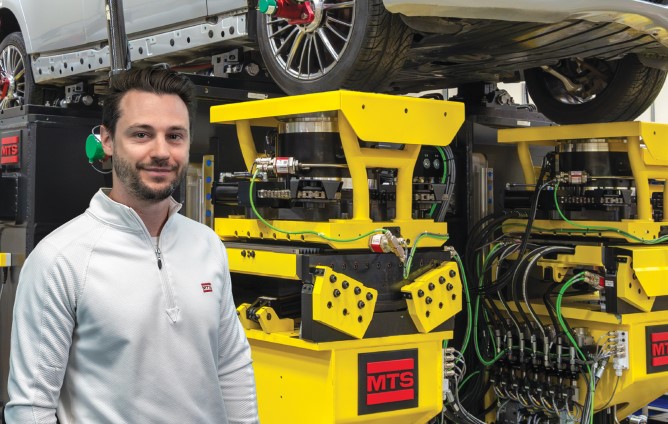
Full Vehicle Energy Consumption
Quantify the fuel efficiency and emissions of a vehicle under various driving conditions.
Quantifying a vehicle’s energy consumption is critical for optimizing fuel efficiency, reducing emissions, and meeting regulatory targets. Automotive OEMs, tier-one suppliers, and research laboratories perform these evaluations to validate vehicle performance under real-world driving conditions and simulated road inputs, enabling engineers to balance efficiency, powertrain performance, and environmental compliance across diverse global markets.
Test Methods
Evaluating full vehicle energy consumption relies on controlled simulation of driving conditions, including city, highway, and transient maneuvers. Key methods include applying precise longitudinal, lateral, and vertical loads to the tires, reproducing road profiles and resistance factors such as aerodynamic drag, rolling resistance, and drivetrain losses. Vehicles are instrumented to measure energy input, torque, speed, and emissions outputs across drive cycles. Laboratory-based dynamometer roadways and hybrid tire-simulation techniques allow repeatable, high-fidelity testing of energy use without dependence on variable external conditions, supporting correlation with on-road test data. These methods enable systematic evaluation of powertrain efficiency, regenerative braking behavior, and subsystem energy contributions.
Test Results
Data from full vehicle energy consumption testing helps manufacturers quantify fuel efficiency, validate emission targets, and optimize hybrid or electric powertrain strategies. Test labs and research institutions use results to benchmark competitors, support regulatory compliance, and refine vehicle systems for maximum energy efficiency under varied operating conditions.
MTS Product Solutions
MTS offers an integrated portfolio for full vehicle energy consumption testing, including precision dynamometer roadways, ride-comfort surfaces, handling roadways, and hybrid tire simulation. These solutions provide repeatable, high-fidelity reproduction of road inputs and drive cycles, enabling accurate evaluation of fuel efficiency, emissions, and energy management across conventional, hybrid, and electric vehicles. Advanced control and data acquisition systems streamline test execution, analysis, and model correlation.
Test Methods
Evaluating full vehicle energy consumption relies on controlled simulation of driving conditions, including city, highway, and transient maneuvers. Key methods include applying precise longitudinal, lateral, and vertical loads to the tires, reproducing road profiles and resistance factors such as aerodynamic drag, rolling resistance, and drivetrain losses. Vehicles are instrumented to measure energy input, torque, speed, and emissions outputs across drive cycles. Laboratory-based dynamometer roadways and hybrid tire-simulation techniques allow repeatable, high-fidelity testing of energy use without dependence on variable external conditions, supporting correlation with on-road test data. These methods enable systematic evaluation of powertrain efficiency, regenerative braking behavior, and subsystem energy contributions.
Test Results
Data from full vehicle energy consumption testing helps manufacturers quantify fuel efficiency, validate emission targets, and optimize hybrid or electric powertrain strategies. Test labs and research institutions use results to benchmark competitors, support regulatory compliance, and refine vehicle systems for maximum energy efficiency under varied operating conditions.
MTS Product Solutions
MTS offers an integrated portfolio for full vehicle energy consumption testing, including precision dynamometer roadways, ride-comfort surfaces, handling roadways, and hybrid tire simulation. These solutions provide repeatable, high-fidelity reproduction of road inputs and drive cycles, enabling accurate evaluation of fuel efficiency, emissions, and energy management across conventional, hybrid, and electric vehicles. Advanced control and data acquisition systems streamline test execution, analysis, and model correlation.
- Flat-Trac Dynamometer Roadways replicate longitudinal and lateral road loads with high accuracy, enabling controlled energy consumption measurements. These systems support repeatable drive cycles, dynamic resistance replication, and correlation of laboratory results with on-road fuel and emissions data.
- Flat-Trac Comfort Roadways reproduce smooth ride inputs for evaluating rolling resistance and subsystem energy consumption. Controlled vertical actuation enables precise measurement of tire and suspension energy losses, aiding in accurate assessment of overall vehicle efficiency.
- Flat-Trac Handling Roadways simulate complex cornering, braking, and acceleration maneuvers to quantify vehicle energy usage under dynamic conditions. They support laboratory analysis of drive-train efficiency, tire energy losses, and regenerative braking performance.
- Hybrid Simulation: ImHIL Tire combines hardware-in-the-loop tire dynamics with real-time vehicle models to reproduce road-induced forces, enabling accurate energy consumption and efficiency testing in a repeatable laboratory environment without full vehicle road testing.