
With more than 30 years of experience in developing innovative test solutions, MTS staff engineer Steve Lemmer brings unique expertise to product design. In this Q&A, he outlines high-temp testing challenges and describes high-temp grip developments.
Q. Why is high-temp testing important?
A. Materials often need to be used in environments that are warmer than room temperature, and engineers need to understand how temperature affects the material properties such as strength, modulus, and creep/rupture. There are three general temperature bands that are used to test different types of materials. There is warm testing up to about 200°C; this is the range for testing plastics and composites. Then there is hot testing which is 200°C-1200°C, with most of that being in the 600°C-1000°C range, the temperatures for testing jet engine materials for example. Lastly, there is ultra-hot temperature at 1200°C and above. This is the range for testing ceramics, carbon materials, and refractory metals such as molybdenum, tungsten and rhenium. One of the challenges is that you use different technologies to achieve these different temperature ranges.
Q. What is something that many people don’t know about high-temp testing?
A. Most people in the testing world understand alignment, temperature, and strain measurement, but as you increase temperature, the complexity of the test setup goes up. It’s relatively simple to put a set of grips and a specimen in an environmental chamber and run a test up to 600°C, but the higher the temp, the more complexity there is in the test equipment and setup. For example, material choice changes, temp measurement devices change, heating methods change, atmospheric environments might change, and eventually the temperatures reach a point where limited technology exists to perform critical test functions.
Even when it's understood that complexity increases with temperature, few realize that complexity can drive cost. Raw materials for these accessories are expensive, and there is often limited commercial availability. These materials are difficult to process into machined components, so part cost is significantly more than the same part made from a traditional steel. If the desired temperatures are in the highest range of greater than 2000°C, carbon or refractory metals may be required in full or partial vacuum environments. Refractory metals make the rest of the expensive superalloys look cheap!
Q. Are there less expensive alternatives for high-temp testing?
A. I would like to say, no. The high-temp solution needs to do specific, challenging things. You can choose less expensive equipment, like the grips or load frame, but those choices often come at the cost of alignment and flexibility. You can choose 'cold grips' made from cheaper materials or a single-zone versus a 3-zone furnace and sacrifice temperature gradients. Other examples of things to consider are: could my test setup create backlash in the load train; does the loading axis change as I apply load; does how I mount a chamber or extensometer to the frame affect test alignment; does friction in my actuator affect the feedback signal of my test? Also, do I care about the ease and flexibility of changing from specimen to specimen? Bottom line, the choices you make may jeopardize test results.
Q. What are some of the challenges of high-temp testing?
A. Temperature measurement, strain measurement, and getting test equipment materials to survive indefinitely are a few. It’s a complex system where all the components interact and everything has to work together: the furnace, contacting and non-contacting strain measurement, load and stroke transducers, control electronics, and specimen grips. You need to understand how the components will interact when you heat the specimen and measure load and strain; and high-temp environments are not conducive to measuring strain on the specimen.
MTS contacting extensometers are designed to apply the smallest amount of side load as possible to the specimen, but they still need to contact the specimen and not slip when applying load. Non-contacting methods work well at lower temperatures, but as temperature goes up, heat and light distortion affect the readings. In addition to these strain measurement challenges, specimen geometries can make testing more difficult. For example, testing flat specimens can be a challenge.
Q. Why is high-temp testing of flat specimens difficult?
A. Gripping flat specimens is more difficult than gripping round specimens because the best way to hold a flat specimen is to apply a normal force directly to the face of the specimen and generate friction forces on the face instead of shear forces on the specimen edges. This wedge grip clamp method typically creates high stresses in the gripping mechanism. MTS has a patented method to use conventional superalloys that can react these stresses while testing specimens at temperatures as high as 1500°C.
Q. What makes MTS Model 680 High-Temp Grips unique?
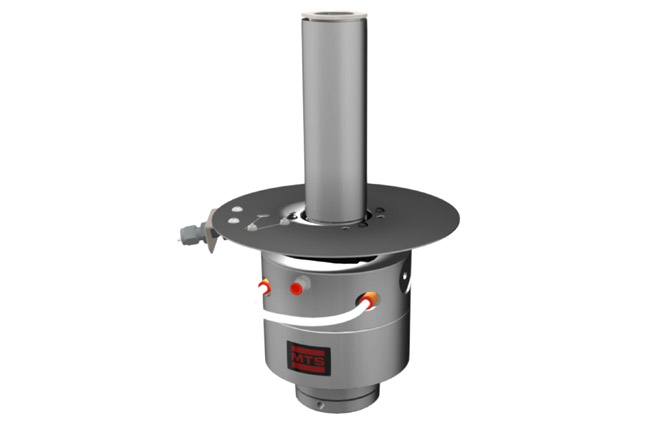
A. The 680 family of hydraulic grips can run fatigue tests consistently and accurately. With mechanical grips, you can’t easily verify the preload applied to the specimen for a fatigue test. The Model 680 hydraulic grips precisely maintain preload throughout the cycling of a test. The 680.01 grip is used for buttonhead and threaded specimens up to 1000°C. The 680.10 expands the capability for 1000°C testing by adding the ability to test flat specimens. The 680.15 can test up to 1500°C, and was designed for testing flat ceramic matrix composites, which are typically more difficult to test due to alignment requirements. Both the 680.10 and 680.15 models can be used to test flat and round specimens—by simply changing out the high-temp components, you can use the same grip to test flat and round buttonhead-end and threaded-end specimens at various temperatures.
Q. What is the advantage of air-cooling of high-temp grips?
A. Air-cooling the high-temp structural components allows testing at higher loads and temperatures with a hydraulic grip. In the 680.10 and 680.15 grips, the air-cooling is internal to the grip components, so it does not disturb the test environment inside the furnace. Keeping the grip temperature higher limits the heat loss in the specimen and improves specimen thermal gradients along the gage section. These grips maintain gradients in accordance with ASTM and ISO guidance ranges from +/-2C or +/-1% of test temperature. Because the grips are hydraulic, they provide the same advantages as our room temperature hydraulic grips: improved alignment repeatability, specimen size flexibility, and consistent and known clamp forces.
Q. What has changed in high-temp testing over the last few years?
A. Developments in energy generation, fuel efficiency and lightweighting are driving the need to go to higher temperatures. From a technology perspective, strain and temperature measurement are also evolving as the higher temps are requiring new technologies. The last thing I would mention is the desire to test the specimen in various environments like fuel exhaust, hydrogen, inert gas and vacuum.
High-temp testing solutions can be bought as individual components from multiple suppliers, but if you want the best integrated solution, you should buy it as a sub-system so that everything works together. If you’re new to high-temp testing, you might not realize all the little things that go into making a test successful. With decades of high-temp testing experience, MTS has the knowledge and products to build an integrated solution for your high-temp testing application.