Aerodynamic Measurement & Characterization
Capture complete vehicle lift, drag and side-forces, as well as individual tire patch down-force data to characterize vehicle air flow and optimize aerodynamic drag and cooling system performance.
Full-vehicle aerodynamic measurement and characterization is essential for optimizing drag, lift, cooling efficiency, and on-road stability. Engineers quantify airflow behavior around the vehicle body, underbody, and wheel assemblies to improve energy efficiency, range, handling and thermal management. This work is typically conducted by OEM aerodynamic groups, motorsports teams, and advanced research institutions that rely on controlled wind tunnel and rolling-road environments to capture accurate force, moment, and tire-patch loading data across a wide range of operating conditions.
Test Methods
Aerodynamic characterization typically combines wind-tunnel testing with road-speed-synchronized moving ground systems to replicate realistic airflow structures. Engineers measure global forces—drag, lift, side force—and moments while also capturing local effects such as wheel wake behavior, cooling-air mass flow and individual tire-patch downforce. Tests commonly involve steady-state sweeps, yaw-angle mapping, cooling-performance evaluations, and underbody flow studies. The moving ground system replicates true relative motion between the vehicle and ground plane, enabling accurate wheel rotation, tire loading, and underbody flow fidelity. These systems support both standard aerodynamic methodologies and advanced studies such as active-aero device characterization, brake-cooling airflow validation and tire–airflow interaction assessment, delivering a highly repeatable environment for aerodynamic development.
Test Results
Aerodynamic test data inform drag-reduction strategies, energy-efficiency targets, lift-balance tuning, cooling-airflow optimization and overall vehicle stability. Manufacturers and research institutions use these results to validate designs, refine CFD models, benchmark competitive vehicles and support certification-related aerodynamic disclosures. Accurate rolling-road data also guide tire-wake management, thermal strategies and development of active-aero control algorithms.
MTS Product Solutions
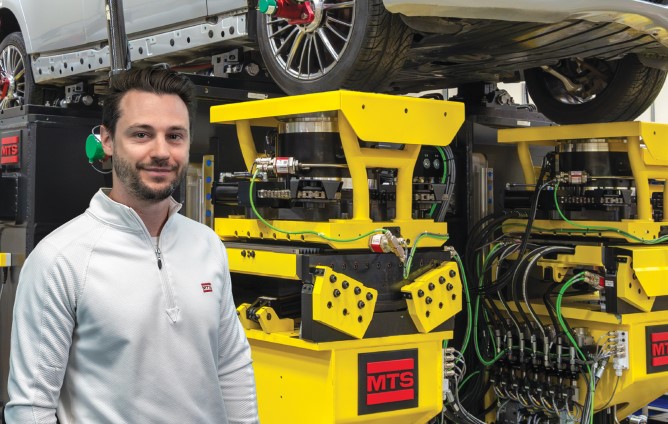
MTS delivers an industry-leading portfolio for full-vehicle aerodynamic development, anchored by Flat-Trac® Rolling Road Systems that accurately replicate real-world ground and tire dynamics inside wind tunnels. These systems offer superior belt speed control, high force capacity, precise wheel-load measurement and excellent under-vehicle flow fidelity. Paired with robust FlexTest® controls and advanced data-acquisition tools, MTS solutions provide repeatable, physics-realistic conditions essential for high-confidence aerodynamic characterization.
Test Methods
Aerodynamic characterization typically combines wind-tunnel testing with road-speed-synchronized moving ground systems to replicate realistic airflow structures. Engineers measure global forces—drag, lift, side force—and moments while also capturing local effects such as wheel wake behavior, cooling-air mass flow and individual tire-patch downforce. Tests commonly involve steady-state sweeps, yaw-angle mapping, cooling-performance evaluations, and underbody flow studies. The moving ground system replicates true relative motion between the vehicle and ground plane, enabling accurate wheel rotation, tire loading, and underbody flow fidelity. These systems support both standard aerodynamic methodologies and advanced studies such as active-aero device characterization, brake-cooling airflow validation and tire–airflow interaction assessment, delivering a highly repeatable environment for aerodynamic development.
Test Results
Aerodynamic test data inform drag-reduction strategies, energy-efficiency targets, lift-balance tuning, cooling-airflow optimization and overall vehicle stability. Manufacturers and research institutions use these results to validate designs, refine CFD models, benchmark competitive vehicles and support certification-related aerodynamic disclosures. Accurate rolling-road data also guide tire-wake management, thermal strategies and development of active-aero control algorithms.
MTS Product Solutions
MTS delivers an industry-leading portfolio for full-vehicle aerodynamic development, anchored by Flat-Trac® Rolling Road Systems that accurately replicate real-world ground and tire dynamics inside wind tunnels. These systems offer superior belt speed control, high force capacity, precise wheel-load measurement and excellent under-vehicle flow fidelity. Paired with robust FlexTest® controls and advanced data-acquisition tools, MTS solutions provide repeatable, physics-realistic conditions essential for high-confidence aerodynamic characterization.
- FlexTest Controllers provide high-speed, multi-channel control architecture that synchronizes rolling-road motion, wheel-force measurement and vehicle boundary conditions. Their precision, stability and configurability ensure highly repeatable aerodynamic force, moment and load measurements across a wide range of test scenarios.
- Flat-Trac Rolling Road Systems create a true moving-ground plane with precise belt speed, high down-force capacity and synchronized wheel rotation. This enables accurate simulation of real-road airflow structures, tire wakes and underbody velocities essential for credible aerodynamic analysis and development.